Blancpain Presents the Lady B, a New Chapter in the Ladybird Collection
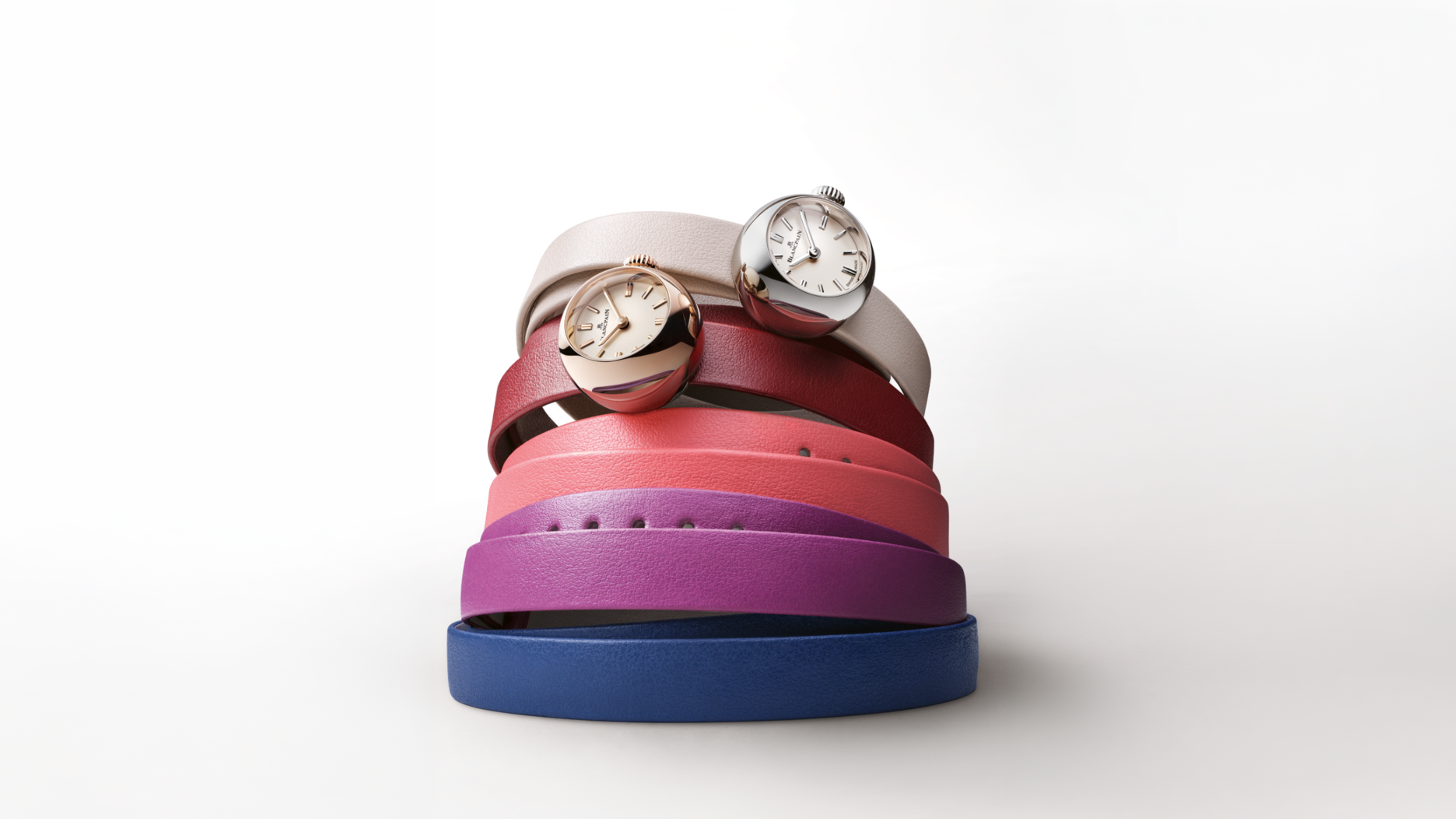

In honour of the 70th anniversary of the Ladybird collection, Blancpain pays tribute to the 1956 Ladybird Bullet. This historic feminine timepiece was created by Blancpain, under the helm of CEO Betty Fiechter, the first woman to lead a Swiss watchmaking house. The Ladybird Bullet was a horological landmark featuring the world’s smallest round movement. Today’s Blancpain Lady B continues Blancpain’s mechanical miniaturisation legacy. Faithful to its motto of never producing quartz timepieces, Blancpain Lady B is powered by the renowned in-house caliber 615, one of the smallest contemporary automatic mechanical movements with a round shape. Its spherical case measures 19 mm in diameter for a volume of just 2.9 cm³, and is paired with a double-tour calf leather strap, making it a true mechanical jewel. Available in stainless steel or 18ct red gold, Blancpain Lady B opens a new chapter in the Ladybird collection. GMT India takes a closer look at the novelty.
.jpg)
Inspired by the Bubble-Form
In the mid-1950s, the world looked towards the future with an almost naive confidence in progress. It was an era of technological optimism, soon extended by the Space Age, when science, innovation, and a fascination with the future profoundly transformed visual culture. Architecture, industrial design, automobiles, and fashion reinvented themselves. Straight lines gave way to organic forms. In 1956, Eero Saarinen designed both the large and the small: the Tulip Chair, whose single pedestal revolutionised furniture design and also the iconic TWA Flight Center in New York. Charles and Ray Eames pursued their exploration of organic forms, while Isamu Noguchi blurred the boundaries between sculpture and object. Cristobal Balenciaga revolutionised the female silhouette with the Sack dress (1957), then the Baby Doll (1958). In automobiles, the General Motors Firebird III (1958) celebrated volume through its emblematic bubble cockpit. In Brussels, the Atomium (1958) made the sphere the icon of the World's Fair and one of the most enduring symbols of 1950s design and optimism. This creative universe inspired the Ladybird Bullet’s unique spherical form. Now, Blancpain Lady B revives its spirit through its spherical case, heir to this biomorphic language of the 1950s.
.jpg)
Reimagining the Lady B
Instead of a straightforward reissue, the Blancpain Lady B is a contemporary reinterpretation of a simple and radical idea born in 1956: to fit fine watchmaking into an object the size of a jewel. In keeping with the spirit of the Ladybird Bullet, it draws inspiration without replicating its lines. Its architecture was built around Blancpain's automatic caliber 615, whose technical specifications were embraced from the very beginning of the project. The spherical case, sapphire crystal, polished rehaut, integrated passthrough strap, and water resistance were all developed in parallel to accommodate the movement within an unprecedented volume. It resembles neither a traditional round watch nor a shaped watch. Its bracelet loop is integrated and passes directly through the case, with no lugs or visible attachment. Conceived in volume rather than surface, Blancpain Lady B is a mechanical bubble: a sculptural object to wear on the wrist.
.jpg)
A Bite-Sized Mechanical Movement
In keeping with Blancpain’s philosophy to stick to mechanical movements and not produce a quartz watch, the Lady B runs on an entirely mechanical movement. At the heart of Blancpain Lady B lies the manufacture caliber 615, measuring 15.70 mm in diameter and 3.90 mm in thickness. It comprises 180 components, 29 rubies, and a power reserve of 38 hours. It beats at 3 Hz or 21,600 vibrations per hour. Its plates are decorated with Côtes de Genève. The geometry of the caseback has been designed to accommodate the specific trajectory of this rotor. Introduced in 1995, the manufacture caliber 615 has undergone continuous refinement, benefiting from technical advancements such as the introduction of a silicon balance spring. Decades of evolution have established it as a proven movement, renowned for its reliability and robustness.
Volume Takes Centre Stage
While a traditional watch is defined by its diameter, Blancpain Lady B is defined by its volume, 2.9 cubic centimetres. It’s an unusual measurement in watchmaking but perfectly suited to an object conceived in space rather than drawn on a plan. At 19 mm in diameter and 13.2 mm in thickness, it fits in the palm of one's hand like a polished pebble. The watch offers a naturally tactile experience. Its subtle vibrations remind the wearer that a mechanical heart beats within.
.jpg)
A Case of Complexity
While the Blancpain Lady B exudes simplicity in its appearance, its case is one of the watch's most complex elements. Over 30 technical drawings were necessary to bring this sphere of just 2.9 cubic centimetres to life. To accommodate the movement, the case is constructed in two parts: the upper and lower sections. The back, slightly smaller than the bezel, remains invisible when the watch is viewed from above. The entire challenge lay in making this architecture disappear. The junction line between the bezel and the back is deliberately obscured through the interplay of volumes, light, and polishing. Achieving a perfectly continuous polish on a sphere this small is one of the major challenges of its manufacture. The result is that of a monolithic volume, as though carved from a single block, even though its construction is far more complex than it appears.
The next challenge was the strap. Since the Lady B forgoes the lugs, the strap passes directly through the case via an opening machined into the solid metal. This geometry of extreme fineness (10 × 1.6 mm) is executed as a single piece. The interior is micro-blasted so the leather glides with fluidity, while the sharp edges and knurling are entirely finished by hand with cabochon tools, according to the traditional techniques of fine watchmaking finishing. At this scale, the slightest gesture becomes decisive. Available in stainless steel or in 18ct red gold, the case is entirely finished by hand. Polished, satin-finished, and micro-blasted surfaces are executed successively on an already-assembled watch, each area carefully protected before working on the next.
An Understated Elegance
Identical on stainless steel and 18ct red gold versions, the dial is dressed in a warm beige opaline hue achieved through gold inlay. Deliberately free of setting, it lets the material and light speak. The applied stick indices are crafted from gold, a signature of the brand. Measuring just 1.82 × 0.39 mm, they illustrate the remarkable level of miniaturisation achieved by Blancpain Lady B. Polished on their upper face and sides, they capture light with subtlety. The two hands, deliberately sober, extend the same quest for purity and readability. Entirely polished, the rehaut acts as a mirror. Its reflections extend the case's curves and reinforce the impression of a sphere carved from the mass.
The Double-Tour Strap
Each Blancpain Lady B comes with a double-tour calf leather strap, available in a choice of seven colours: white, beige, mocha, burgundy, blue, coral or purple. Closed with a pin buckle, it wraps naturally around the wrist and transforms Blancpain Lady B into a true jewel. It complements a tailored suit, disappears under the cuff of a white shirt, dialogues with a collection of bracelets and rings, or speaks for itself. The Blancpain Lady B stands at the crossroads of watchmaking and jewellery, defying singular definition and thriving in its paradox.
Image credits: Blancpain