Jaeger-LeCoultre Brings the Reverso to Venice for Homo Faber


Jaeger-LeCoultre has reimagined the Reverso’s blank caseback as a layered gallery wall, rendered four times over. The new Reverso Tribute Enamel ‘Turner Series’ reproduces four Venetian oils by J.M.W. Turner in miniature, timed to the Manufacture’s presence at this year’s Homo Faber Biennale in Venice. Each of the four references is limited to 10 pieces, cased in 18K white gold at 45.6 × 27.4 mm and 9.73 mm thick, water-resistant to 3 bar, and paired with a black alligator strap. The enamel illustration on each watch required roughly 80 hours of work, most of it devoted to a single challenge: how to compress a canvas into 2 cm² without sacrificing the light and intricacy that made the original worth painting.
Fourteen Layers of Stroked Intricacy
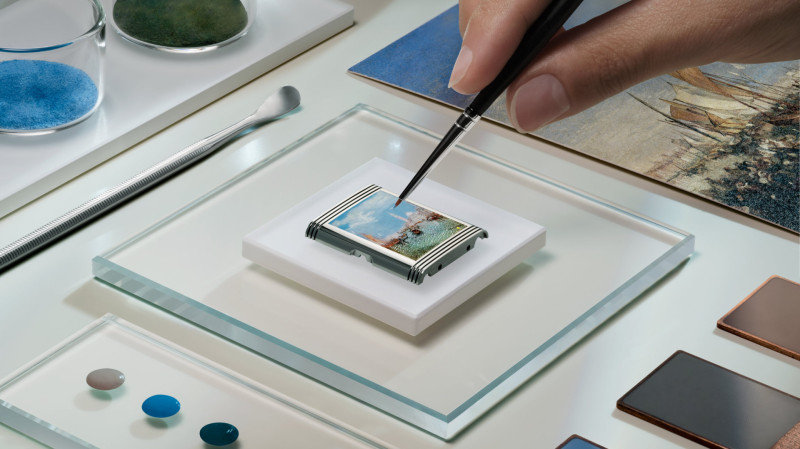
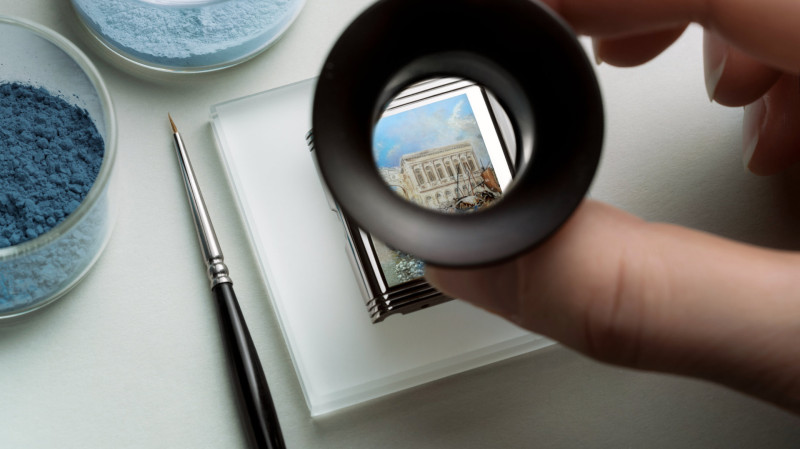
The casebacks are the work of Jaeger-LeCoultre's Métiers Rares™ atelier, executed in enamel miniature painting and paillonage. To give the clouds a hovering appearance rather than flat, the enamellers paint them into the original miniature, stroke two translucent layers over them, repaint the clouds on top, then seal the whole composition beneath two further translucent layers, each stage fired separately at 800°C. The water draws the viewer in with its intricacy: silver leaf sits beneath translucent coloured enamel, catching light unevenly the way an actual lagoon does. Each caseback is caressed with brushes with 14 layers to count, and a gold-leaf paillon hidden somewhere in the composition signs the piece, the enameller's private, near-invisible mark.
Turner’s Palette, Cast in Four Dials
The dials respond to each caseback instead of following a single house pattern, each hand-guilloché beneath Grand Feu enamel. The Dogana and San Giorgio Maggiore reference (Q39334W1), after an 1834 oil now at the National Gallery of Art, Washington, adopts a new soleil croisé guilloché with 180 lines and 1,080 lathe passages. The Porch of Madonna della Salute watch (Q39334W2), drawn from an 1835 canvas at the Met, carries a vertical barleycorn guilloché across 70 lines and 420 passages.
Bridge of Sighs, Ducal Palace & Custom House (Q39334W3), based on an 1833 Tate Britain oil —Turner’s first Venetian painting in oils and a homage to Canaletto, seen at his easel in the original composition — features a basket-weave guilloché of 46 lines and 276 passages. The final reference (Q39334W4), after Tate Britain’s 1840 Bridge of Sighs, exhibited with two lines Turner adapted from Byron on a bridge standing between a palace and a prison, answers with a wide horizontal wave guilloché of 41 lines and 369 passages.
Each dial requires a further eight to nine hours of enamelling after engraving, built across five layers and six or seven firings. Faceted hour markers, set through cured enamel without a hairline crack, meet the chemin de fer minute track in a display of quiet precision, finished with the restrained Dauphine hands and applied indexes found across the wider Reverso Tribute range.
Underneath the Cape of Blue
Powering all four references is the Calibre 822, Jaeger-LeCoultre’s manually wound movement built specifically for the Reverso’s rectangular case. Measuring under 3 mm in height, it runs at 21,600 vibrations per hour (3 Hz) and delivers a 42-hour power reserve, a specification that has anchored the time-only Reverso Tribute line for more than two decades. Here, it asks for no attention beyond keeping the case slim enough for the decoration to carry the wat
Image credits - Jaeger LeCoultre