Why the Piaget Polo 79 Two-Tone Feels Right for 2026

“A Piaget watch is first and foremost a piece of jewellery,” Yves Piaget used to say, and he wasn’t interested in being modest about it. At this maison, gold is a primary source of creative friction. The noblest of metals—possessing the colour of the sun and an everlasting sheen—runs through Piaget’s story like a gleaming seam of inspiration. It is so vital to the brand’s vision that the metal is still melted in-house, in their own Geneva foundry, a process that allows for a level of artistic plasticity the rest of the industry simply couldn’t fathom during the steel-crazed late seventies.
By 1979, Yves Piaget—a man who spent as much time in a polo saddle as he did in a boardroom—decided that ‘sporting’ and ‘precious’ weren’t mutually exclusive. He fused the grit of the polo field with the high-gloss glamour of a jet-set that included everyone from Andy Warhol to the Studio 54 regulars. The result was the Piaget Polo. With its case shaped somewhere between a circle and a square, it captured the unique zeitgeist of the era, appearing as a singular, sculptural ribbon. “A bracelet watch and a watch bracelet,” as Yves called it. It was a defiant rejection of the tool watch obsession, and in 2026, that same liquid architecture feels like the only relevant response to a world rediscovering the merits of the cocktail-sports hybrid.
Staccato of Gold
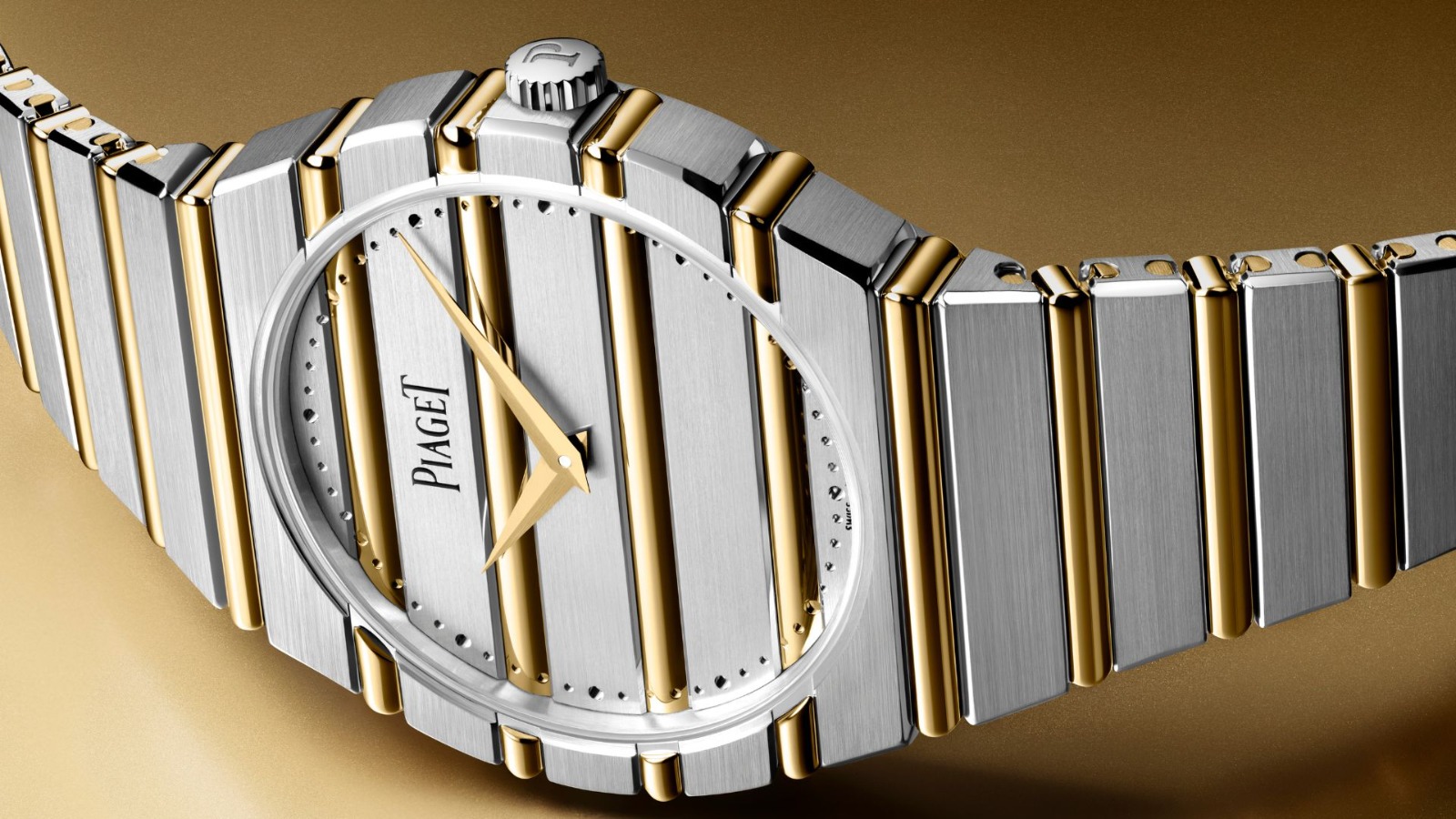
In 2024, the original Polo was reborn as the Piaget Polo 79 to mark the Maison’s 150th anniversary, promptly securing the ‘Iconic Watch’ prize at the GPHG. Now, in 2026, Piaget has introduced the Two-Tone, a harmonious marriage of metals that recalls one of the original 1979 configurations, designed for those who demand distinction without sacrificing wearability.
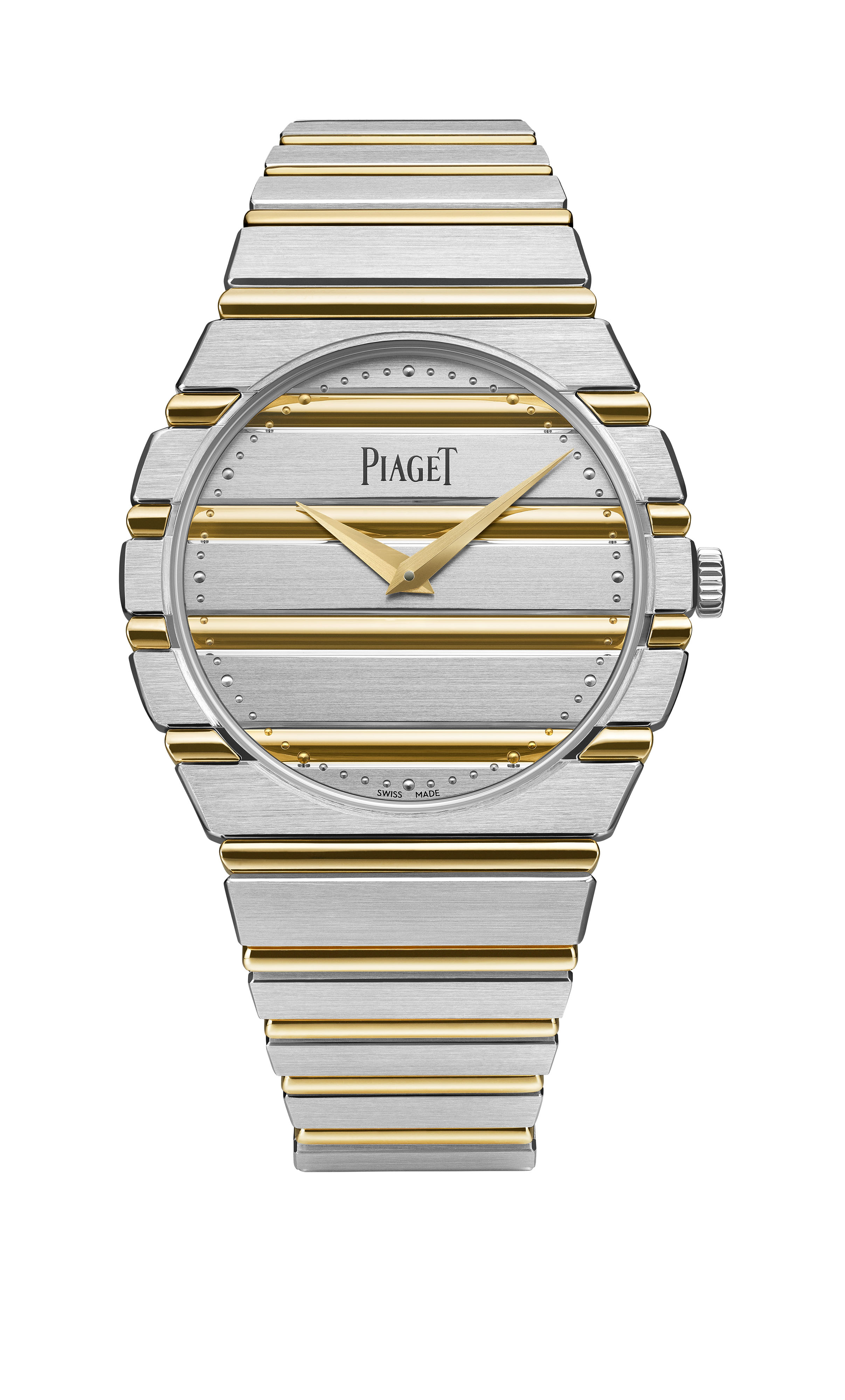
The Polo’s silhouette is defined by its refusal to acknowledge where the case ends and the bracelet begins. It is an integrated form in the most literal sense, structured by the rhythmic staccato of its gadroons. In this new configuration, the effect is amplified through optical friction: brushed 18k white gold provides an architectural foundation, while polished 18k yellow-gold gadroons slice through the surface with a deliberate, rhythmic intensity. The 38mm case ensures the piece wears with the ease of a second skin.
Material Purity
While much of the industry remains preoccupied with the steel and gold compromise, Piaget operates with a different level of material integrity. This is not merely a bi-colour watch; it is 18-carat gold on 18-carat gold, a manifesto of Extraleganza for a generation that finds the ubiquitous steel bezel increasingly…pedestrian.
The dial is a solid yellow gold slab, stripped of the usual horological attributes—no date window, no luminescent markers, no distractions—save for the elegant sweep of the 18k yellow gold hands. It is a pure expression of form that remains practical for daily life, offering a water resistance of 50 metres. This commitment to metal purity proves that a sports watch can be precious without being fragile.
The Technical Heart
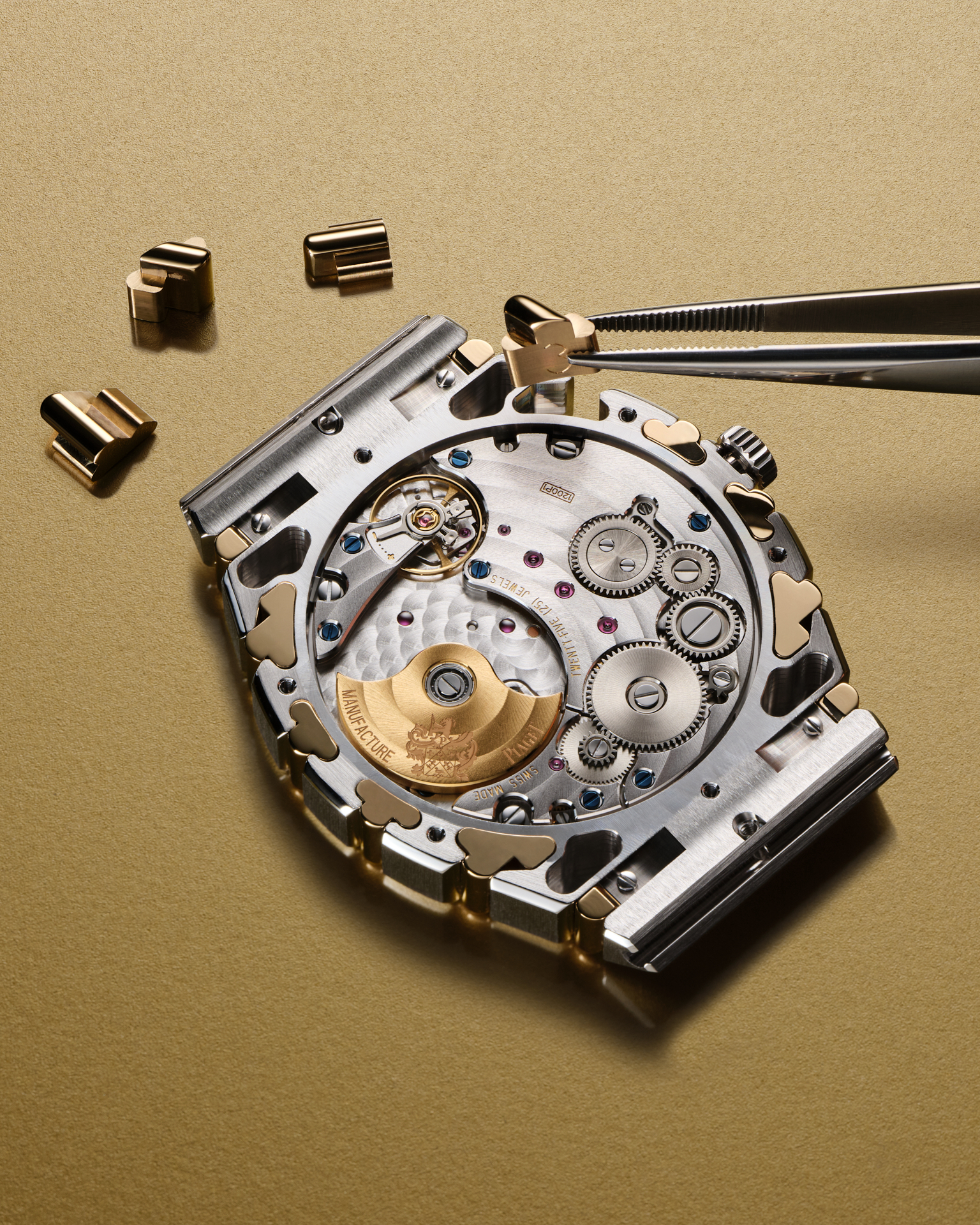
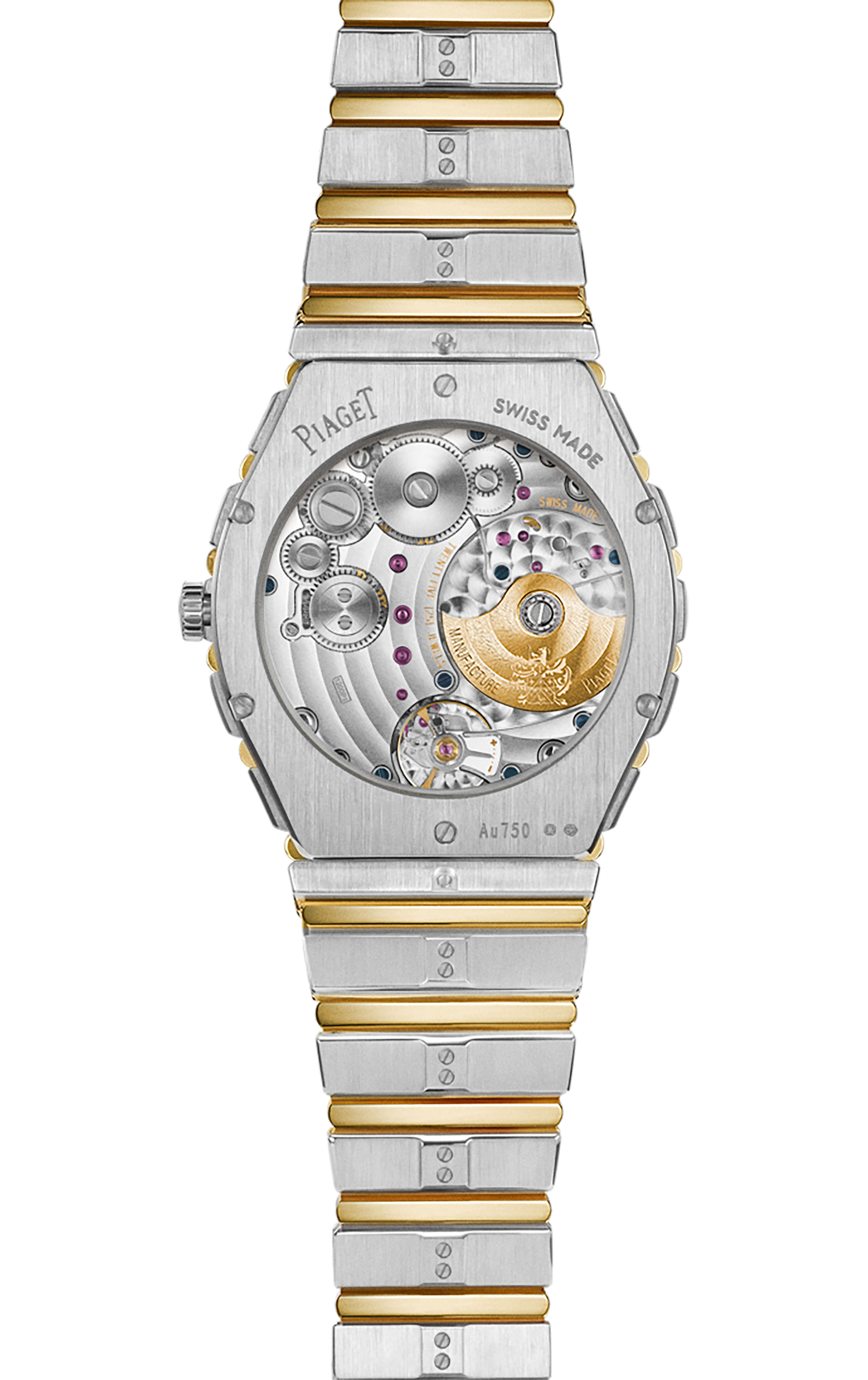
The Two-Tone Polo is a feat of ultra-thin engineering, powered by the Manufacture Calibre 1200P1. This self-winding movement, visible through a sapphire crystal caseback, measures a scant 2.35mm in thickness and features a 22k gold micro-rotor, a technical flex that allows the watch to retain its legendary drape. This engineering achievement ensures the watch maintains the silky, low-slung profile that has become synonymous with Piaget’s approach to luxury. There is a clear through-line between the aesthetic rebellion of 1979 and the cultural landscape of 2026. Both eras share a desire for pieces that feel personal and provocative. The original Polo was the chosen uniform of the Piaget Society—artistes who ignored the status quo in favour of a more flamboyant, individualistic elegance.
The modern collector is looking for that same maverick spirit. In a sea of identical steel bezels, the Two-Tone Polo stands out as a triumph of Extraleganza. It is the ultimate cocktail-sports hybrid, a piece that understands the most interesting designs are the ones that refuse to choose a side.
Image credits: Respective brands