Dials that Cradle the Moon: The Moonphase Complication in Watchmaking
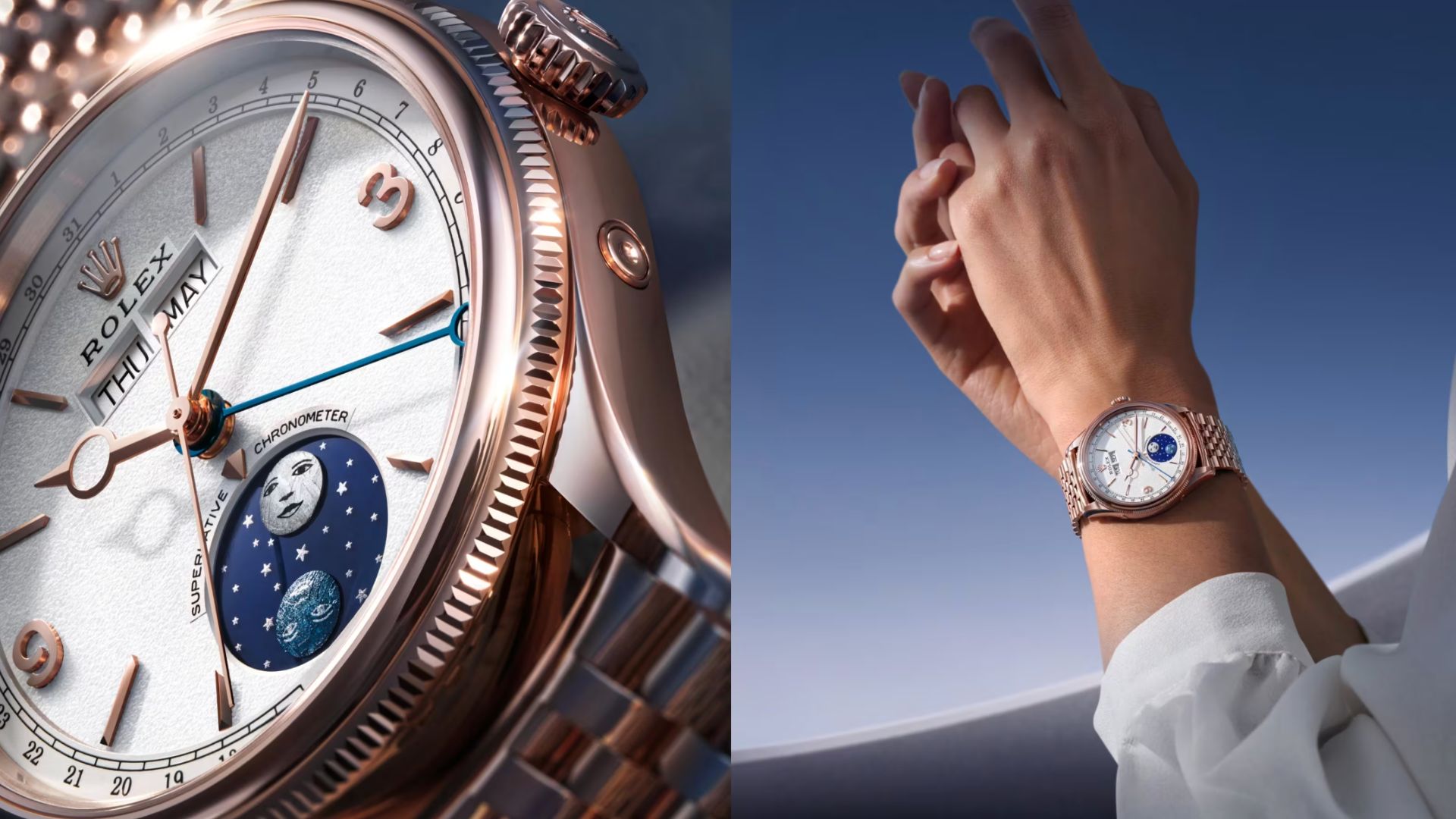

For seven decades, Rolex behaved as though the moon belonged to someone else's mythology. Nearly every serious watchmaker eventually yielded to the complication, for it asks little of function yet promises much of sentiment: a painted disc, a languid rotation, an unspoken vow that the instrument on one’s wrist answers to something older than mechanics themselves. Then, on the fifteenth of September — this time in Milan rather than Geneva — Rolex reconsidered. What emerged was not a concession but a fresh vantage on the night sky, rendered with the brand’s signature restraint. And from this turning point, GMT India selects its five most admired moonphase timepieces.
The Dial that offers a window into the night sky
Rolex: Perpetual Padellone
The reluctance was never a matter of competence. In the early 1950s, the brand produced a small run of complete calendar watches bearing moonphase displays, among them a broad, flat-cased reference that Italian dealers christened Padellone for its resemblance to a wide frying pan. Fewer than 1500 examples emerged across all metals before the line quietly lapsed. Rolex revisited the notion only once more in 2017, folding a moonphase into the Cellini collection, its most old-world and unhurried offering. That undertaking also ended in 2023, when Cellini itself was discontinued. For a brand otherwise defined by unbroken continuity, the moon kept arriving and departing like a guest who never fully settled into the household.
The latest model, Perpetual Padellone, inherits its name and dial architecture from the 1950s original, yet answers to wholly new mechanics: a complete calendar that advances day, date, and month in a single instantaneous motion at midnight, a 5-hertz movement engineered around some 30 pending patents, and a moonphase disc strewn with stars, its full and new moon cut from meteorite. It is the first moonphase Rolex has ever installed within a permanent, ongoing collection rather than a limited or eventually abandoned one. Even Rolex, eventually, looks skyward.
The purist that evinces an ultra thin moon
Jaeger LeCoultre: Master Ultra thin moon
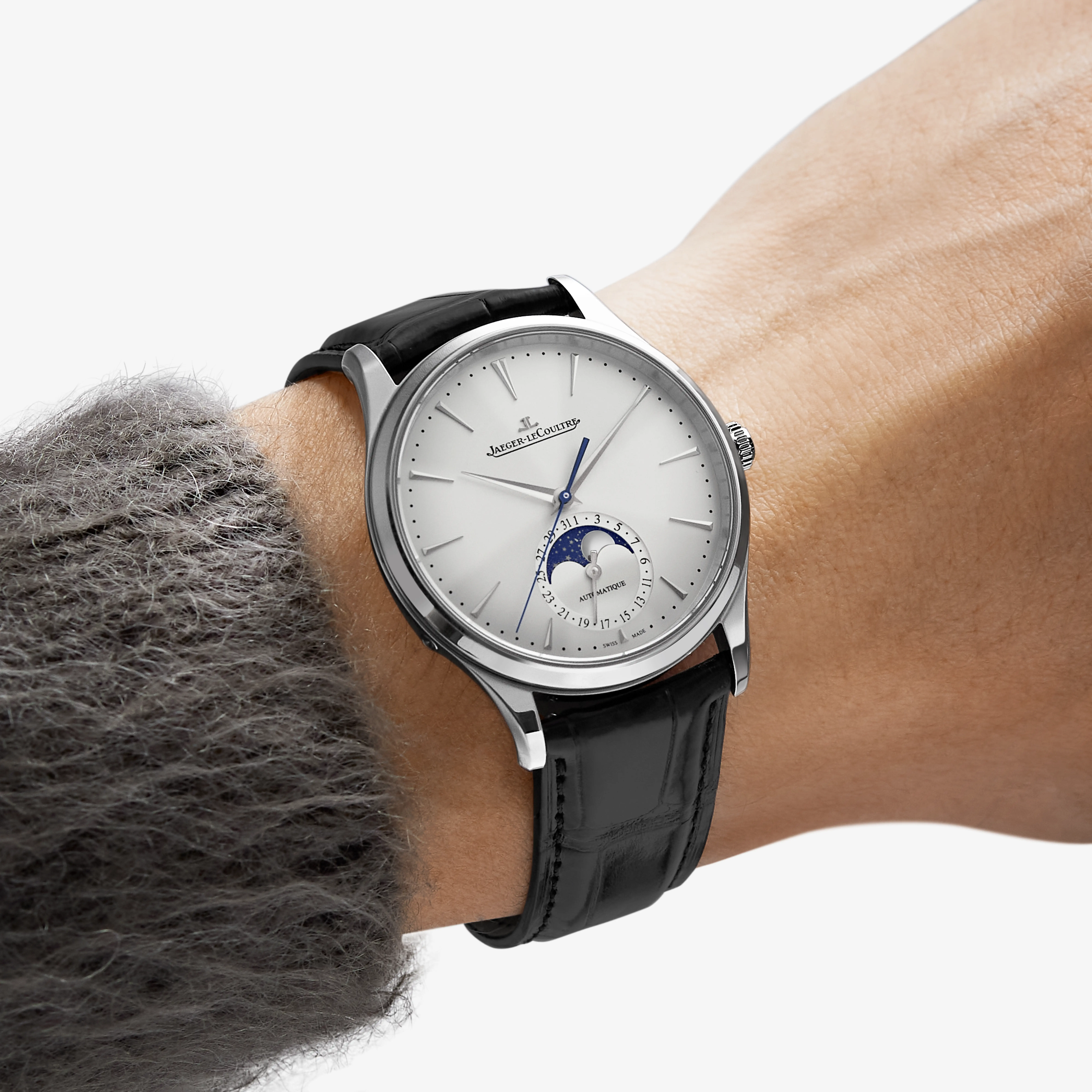
Jaeger‑LeCoultre (JLC) has never needed to declare its devotion; it is woven into the very constitution of the House. Founded in 1833 in the valley town of Le Sentier, the manufacture built its reputation on movements of such refinement that even Patek Philippe once relied on JLC calibres for its own creations. That same unhurried exactitude produced the Caliber 101 — still the smallest mechanical movement ever made — and today yields the Master Ultra Thin Moon, a midnight blue firmament scattered with stars, offered without fanfare, for those who were never in need of persuasion.
An innovation born to compete with a marine chronometer
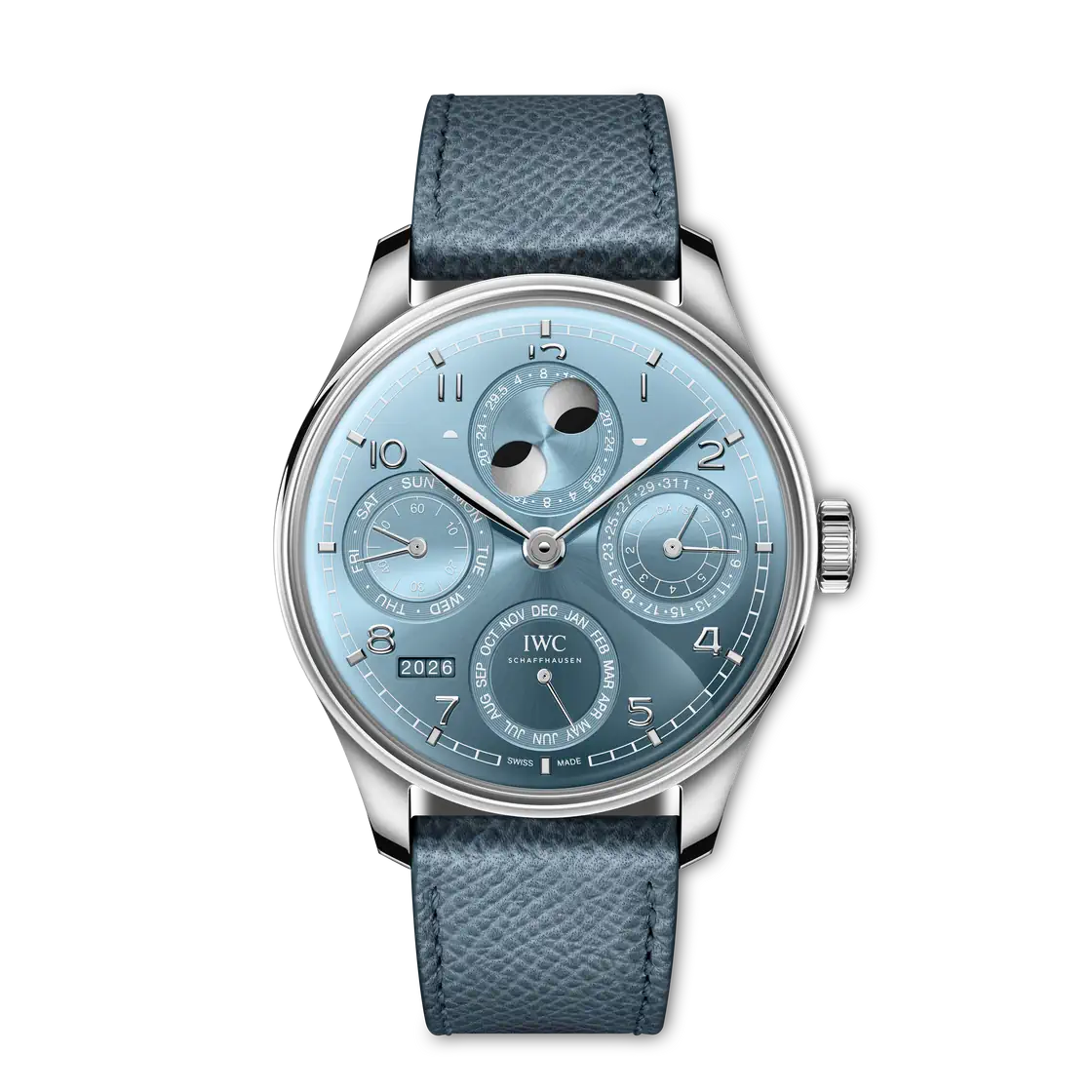
IWC: Portugieser Perpetual Calendar
IWC approaches the moon as it approaches everything else, as an engineering proposition before a romantic one. The Portugieser exists because two Portuguese merchants arrived at the Schaffhausen workshop in the late 1930s demanding a wristwatch as accurate as a marine chronometer. IWC's solution was almost defiantly literal: a pocket watch movement, encased whole, producing something startlingly oversized for its era. That identical appetite for calculating decades, then centuries, ahead now animates the Portugieser Perpetual Calendar, whose lunar indication strays by a single day only once every few hundred years. This is not a poet's moon. It is an astronomer's.
The witness that went on a lunar voyage
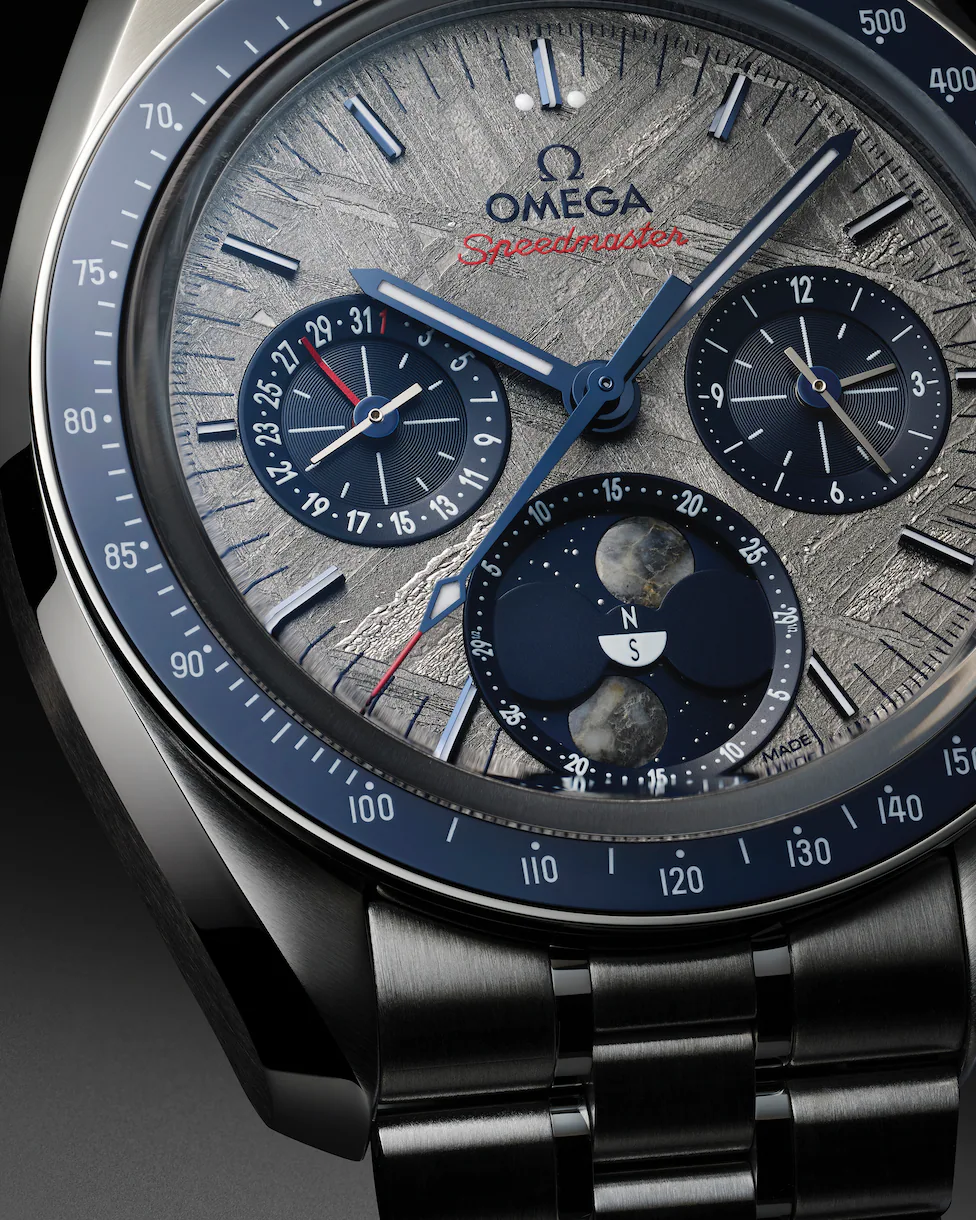
Omega: Moonphase (De Ville/Speedmaster)
Omega need not imagine the moon, having already visited it. The Speedmaster began in 1957 as a motorsport chronograph, only to be conscripted by NASA and worn during America's lunar missions, an accident of history no marketing department could have engineered. What the brand's moonphase pieces, across the De Ville and Speedmaster lines, carry is not invention but recollection. When Omega renders the moon on a dial, the result resembles a photograph more than a metaphor.
A luminescence that was born of radium
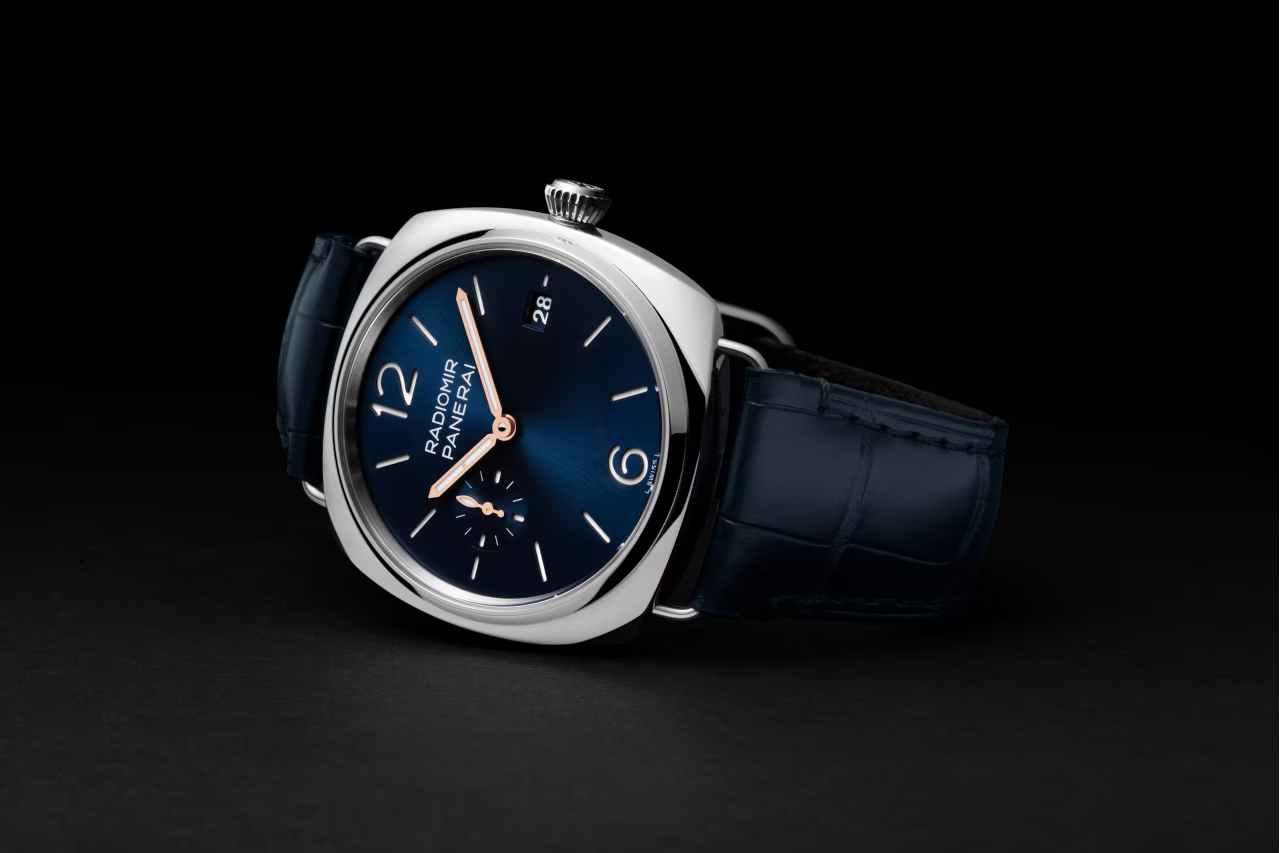
Panerai: Radiomir Moonphase
Panerai arrives at the complication almost by ambush. Its Radiomir case was conceived in the 1930s for the frogman commandos of the Italian Royal Navy, oversized, water-resistant, engineered for men submerged in darkness rather than admirers studying a dial by candlelight. Grafting a moonphase onto that lineage ought not to succeed. It does, precisely because the contrast is the substance. An instrument forged for clandestine combat.
An invitation to a heritage tour
Longines: Master Collection Moonphase
Longines demands none of that severity. Established in Saint-Imier since 1832 and bearing one of horology's oldest unbroken trademarks, the House has always treated elegance as something extended rather than something to be earned through hardship. The Master Collection Moonphase, its modest lunar disc encircled by a date ring, is where a great many admirers first encounter the complication, not as a rarity to be pursued, but as an invitation they may simply accept. It requires curiosity alone, never credentials.
Six maisons, one complication, and a cascade of sentiments into the curation
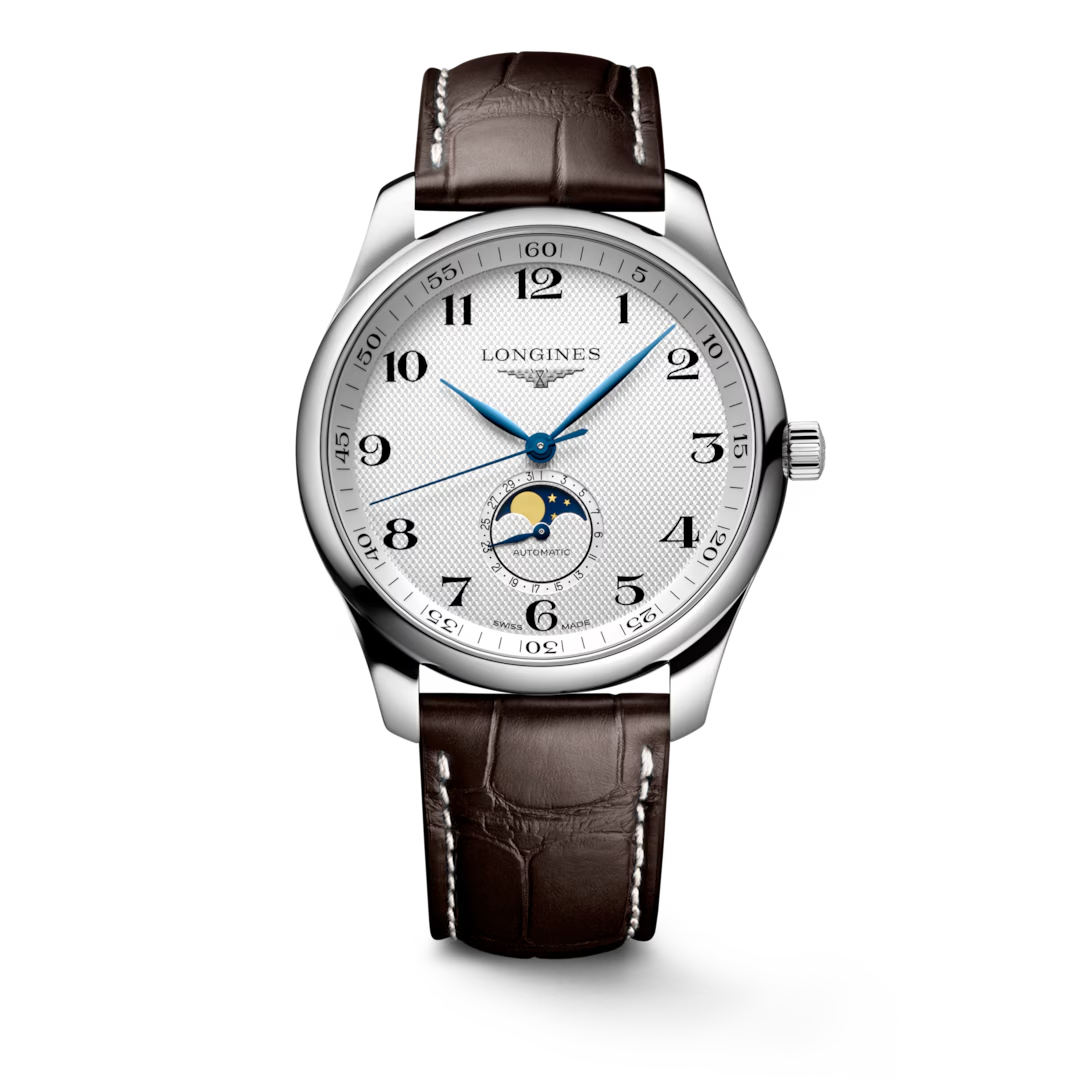
Image Credits - Rolex, Jager LeCoultre, IWC, Omega, Panerai, Longines