India is woven into Favre Leuba’s heritage: Patrik Hoffmann

As horology embraces high fashion, Indian couture is bringing a richly distinctive vernacular to the wrist. Think bracelets articulated with zardozi embroidery, dials animated by mukaish-like constellations, or guilloché reinterpreted through the geometry of brocade. The possibilities are wide and audacious.
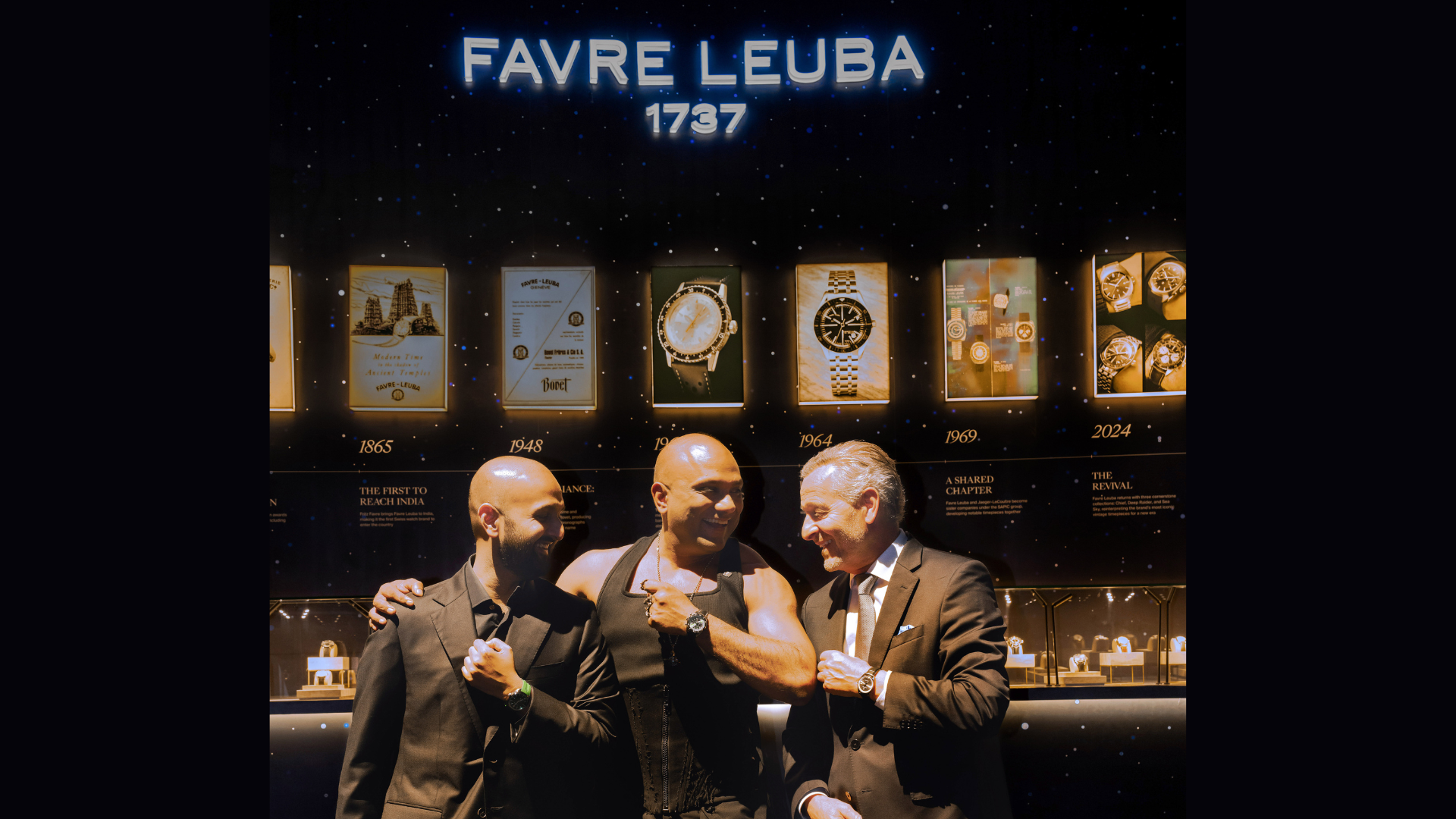
This convergence took a compelling form recently when Indian couturier Gaurav Gupta collaborated with Favre Leuba, a Swiss maison with an unusually resonant Indian provenance. In 1865, Fritz Favre travelled to India, making Favre Leuba the earliest Swiss watch brand to establish a presence in the subcontinent. Over the decades, rugged signatures such as the Sea King, Sea Sky and Bivouac have acquired an almost talismanic status, becoming prized possessions and, eventually, heirlooms handed down through generations of Indian families.
%20(1).jpg)
The collaboration unfolded alongside Gupta’s latest couture collection, Light Song. On this occasion, GMT India had the opportunity to sit down with Patrik Hoffmann, CEO of Favre Leuba, and talk about modernising heritage, the catalytic power of creative collaborations and India’s growing significance in the contemporary luxury-watch landscape.
This interview is edited and condensed.
GMT India: Favre Leuba has partnered with Indian couturier Gaurav Gupta. What made this collaboration the right fit?
Patrik Hoffmann (PH): Collaborations are inherently a part of Favre Leuba’s history. Back in the 1940s, ‘50s and ‘60s, the brand worked with names such as Patek Philippe, Zenith, Bovet, Jaeger-LeCoultre and IWC. When the opportunity to work with Gaurav Gupta came through, it felt like a natural fit. Watches combine mechanics, design, fashion and craftsmanship, and Gaurav’s work embodies those same values. The storytelling is strong, and that’s important because watchmaking brings together many different crafts and professions. What also makes this partnership exciting is the cultural exchange. We are bringing Swiss watchmaking to India, while Gaurav Gupta and his team are taking Indian design to the global stage.
GMT India: How did the collaboration come together, and where did you see the connection between Indian couture and Swiss craftsmanship?
PH: The collaboration was initiated through our partners, Ethos Watches, who are our exclusive distributor in India. The idea actually came from their team, and I was immediately drawn to it because the convergence of fashion, craftsmanship and watchmaking is incredibly compelling. The watch industry has also evolved significantly over the last two decades. Product cycles have become much shorter, and fashion now plays a far greater role than it did in the past. That makes collaborations like this even more relevant as they bring fresh storytelling to traditional watchmaking.
GMT India: India has become an increasingly important luxury market. What role does the country play in Favre Leuba’s long-term strategy?
PH: India is one of our most important markets, and our history on Indian shores plays a big role in that. Favre Leuba was the first Swiss watch brand to enter India in 1865, so the country is deeply woven into the brand’s heritage.
Whenever I meet Indian collectors or customers, I hear personal stories. Some tell me it was their father’s watch, others say it belonged to their grandfather or that it was a wedding gift. Those emotional connections make India unique for us.
GMT India: Favre Leuba has more than 160 years of history. How do you balance that heritage with the expectations of modern consumers?
PH: Heritage is one of our greatest strengths, but heritage doesn’t mean copying the past. It's easy to recreate a vintage watch and present it as a retro reissue — that has become quite fashionable today. We are deliberately not taking that route.
Our responsibility is to take the brand’s history and evolve it in a way that feels contemporary while remaining true to its DNA. That’s the balance we are constantly trying to achieve. It’s also how we hope to connect with a younger generation, particularly in India, where the brand already has such a rich legacy. The challenge is to respect the past while creating products that feel relevant today. I believe that’s what we’ve achieved so far, and it’s the direction we’ll continue to pursue.
GMT India: What role has Ethos played in the brand’s growth story in India?
PH: I’ve known the Ethos team for almost two decades now, and have worked closely with them since around 2018. When the opportunity arose to team up with Favre Leuba, the partnership with Ethos became instrumental. India is a priority market for us, and Ethos is the country’s leading luxury watch retailer. More importantly, they understand the market and know their customers exceptionally well. That local knowledge is invaluable when relaunching a heritage brand.
Image Credits: Favre Leuba


.png)