Inside the Intellectual Interior of the Blancpain Ladybird
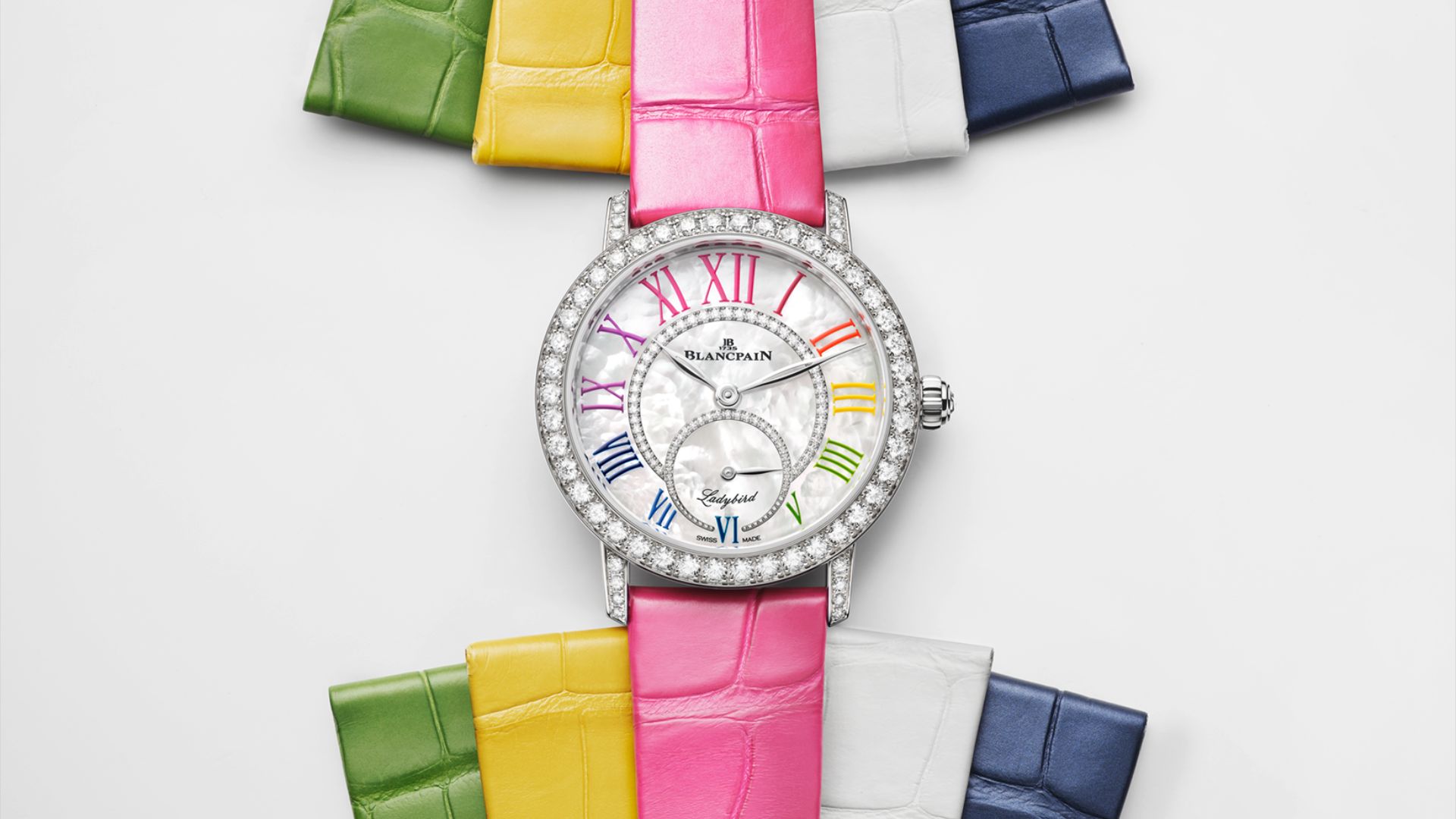

The history of watchmaking is often narrated with a feverish obsession with the colossal: the highest peak, the deepest trench, the fastest lap. This linear obsession with ‘the most’ tends to ignore the technical brutality required for ‘the least’. In 1956, when Blancpain released the original Ladybird, the R550 movement was a defiance of physics. At 11.85mm in diameter, it was a mechanical pulse reduced to its absolute minimum, proving that horological complexity did not require a massive footprint.
There’s a bit of irony in the way we perceive the wristwatch. In the 19th century, while men remained tethered to the pocket watch—an object of sedentary, patriarchal status—women were already strapping time to their wrists. These early montres-bracelets were experiments in miniaturisation. It was the arrival of 20th-century trench warfare that rebranded the wristwatch as a rugged tool, a transition that effectively relegated women’s watches to the realm of the decorative. For decades, the industry operated under the assumption that a woman’s time did not require the same mechanical rigour as a man’s. Horology has long equated itself with masculine archetypes, creating a vacuum wherein mechanical excellence was reserved for the large-diameter case, leaving the smaller wrist with quartz or pared-down compromises.
The Intellectual Interior
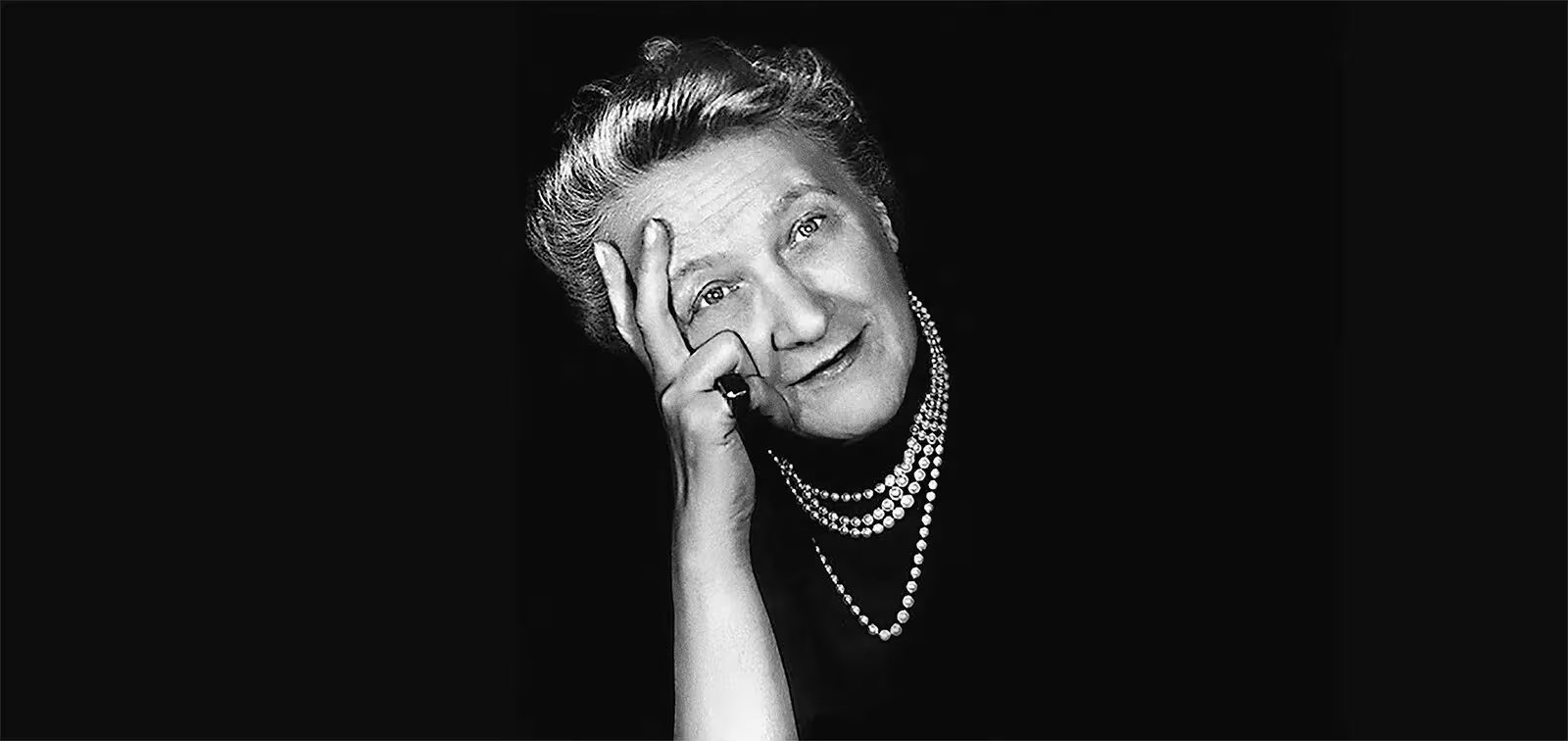
The refusal to inhabit this vacuum was orchestrated by Betty Fiechter. Taking the helm of Blancpain in 1933, she was the first woman to lead a major Swiss manufacture. Fiechter identified that the jewellery watch suffered from a persistent intellectual vacancy. She operated on the conviction that a diminished radius should not necessitate a diminished intellect in the engine itself. This was a foundational mandate that had already manifested in 1930 with the Rolls—the first self-winding wristwatch for women. It was a pioneering acknowledgement of women’s appetite for mechanical autonomy, arriving decades before the industry’s wider consciousness was prepared to catch up. This lineage was codified in 1956 with the Ladybird, a piece housing a movement that was, at the time, the world’s smallest round mechanical pulse.
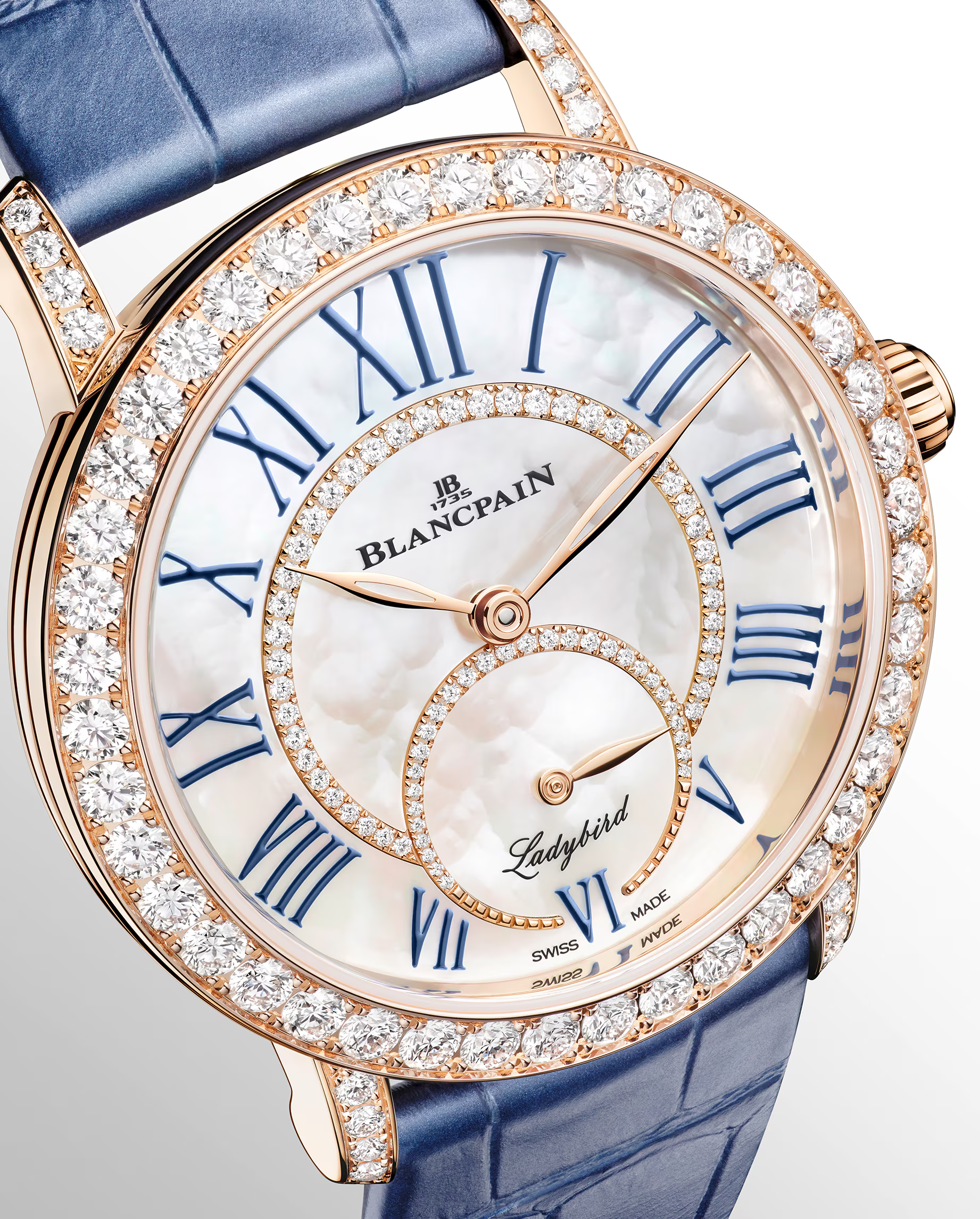
The current Ladybird Colors collection functions as a modern continuation of this rigour. The 34.9mm white and red gold cases carry a physical gravity that isn’t dependent on the carat count of the diamonds. There is a specific tension in the dial layout—the asymmetric Roman numerals seem to radiate from the centre, creating a sense of kinetic energy. The mother-of-pearl dial adds a layered depth of field that catches the light with a fluid quality.
Mechanical Ingenuity
Inside these pieces sits the Calibre 1153, a movement originating from Blancpain’s dedicated facility in Le Brassus. It provides a 100-hour power reserve, achieved through a series-coupled twin barrel system—a figure that remains a rarity in watches of this scale. This four-day autonomy is a functional statement. It assumes a wearer whose life requires the watch to keep pace without constant intervention. The silicon balance spring ensures the movement remains unaffected by the magnetic fields of a modern environment, bringing tool-watch durability to a high-jewellery silhouette.
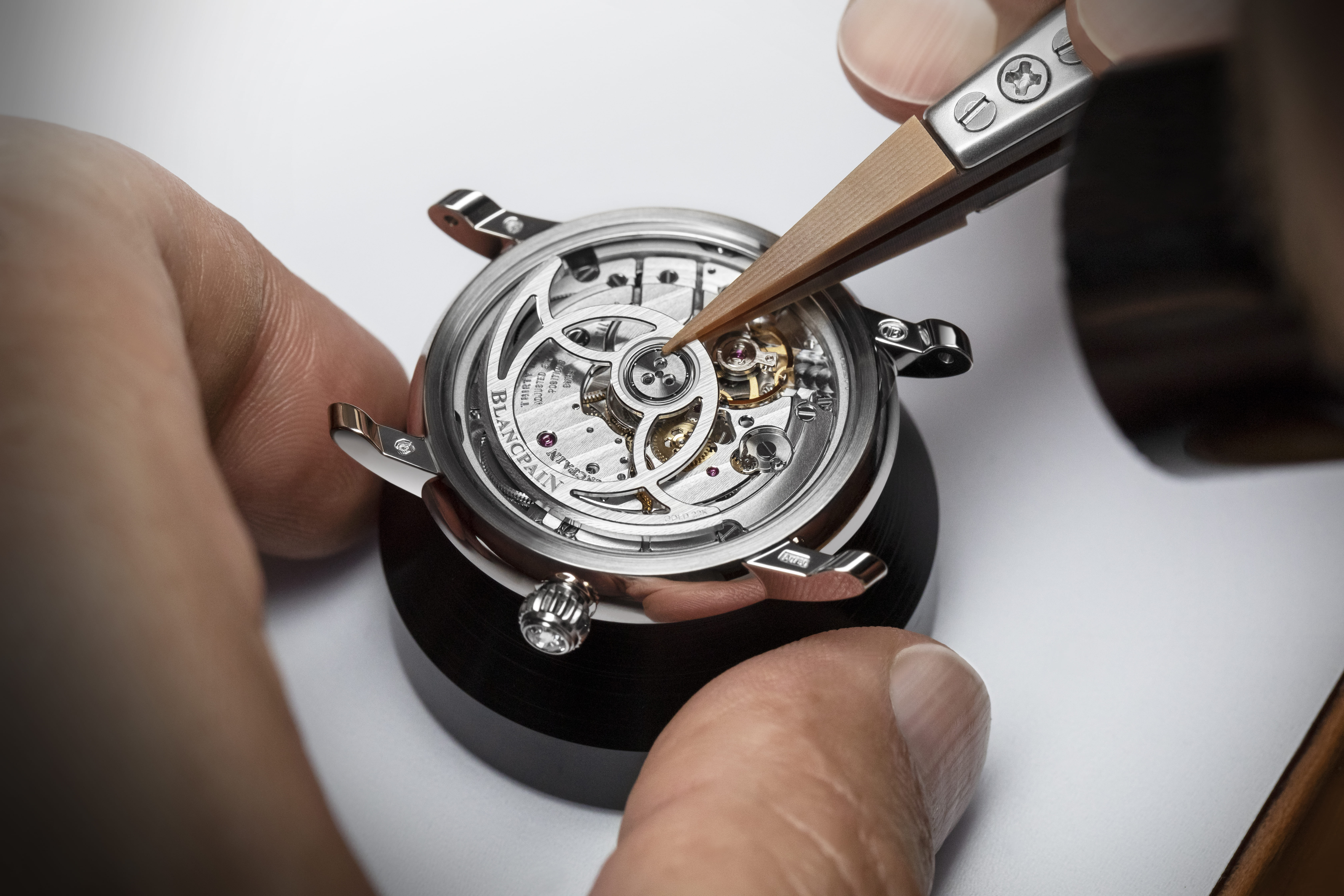
The Phase de Lune models introduce a narrative element that feels historically grounded. The moon phase complication, with its signature beauty mark on the moon’s face, serves as a direct link to Blancpain’s 18th-century heritage. It is a complication that prioritises the slow passage of time over the frantic ticking of seconds. The gold rotor, visible through the sapphire caseback, is open-worked and finished with a circular graining that matches the standards applied to the brand’s most complex perpetual calendars. The gem-setting or sertissage is performed at their atelier, ensuring the stones do not merely sit on the gold but are integrated into the architecture of the case.
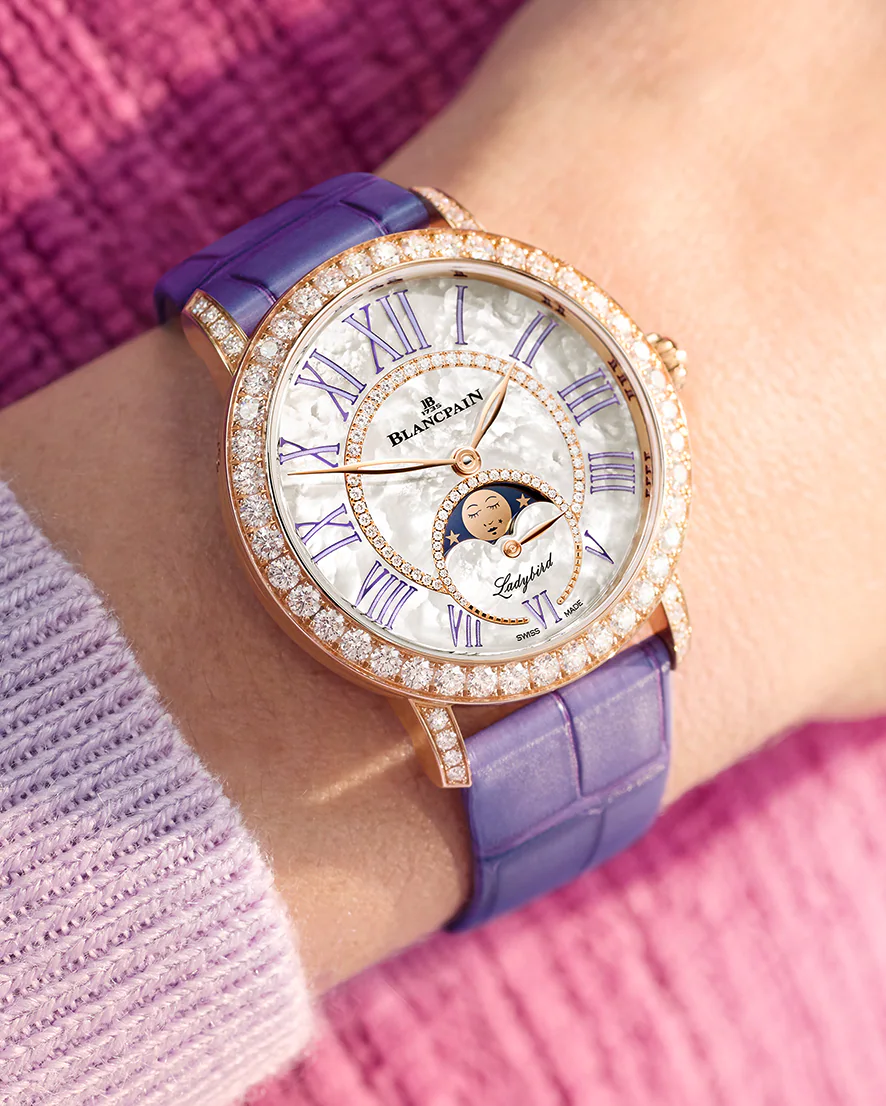
The Ladybird avoids the ‘shrink and pink’ methodology of the mid-20th century. It offers a mechanical identity that refuses to be a secondary thought. By embedding a high-autonomy, twin-barrel movement within a high-jewellery frame, Blancpain collapses the artificial distinction between the instrument and the ornament.
Image credits: Respective Brands